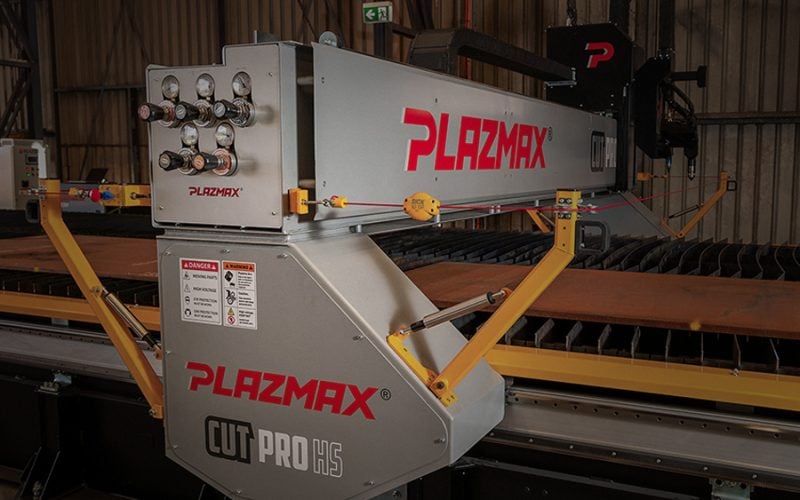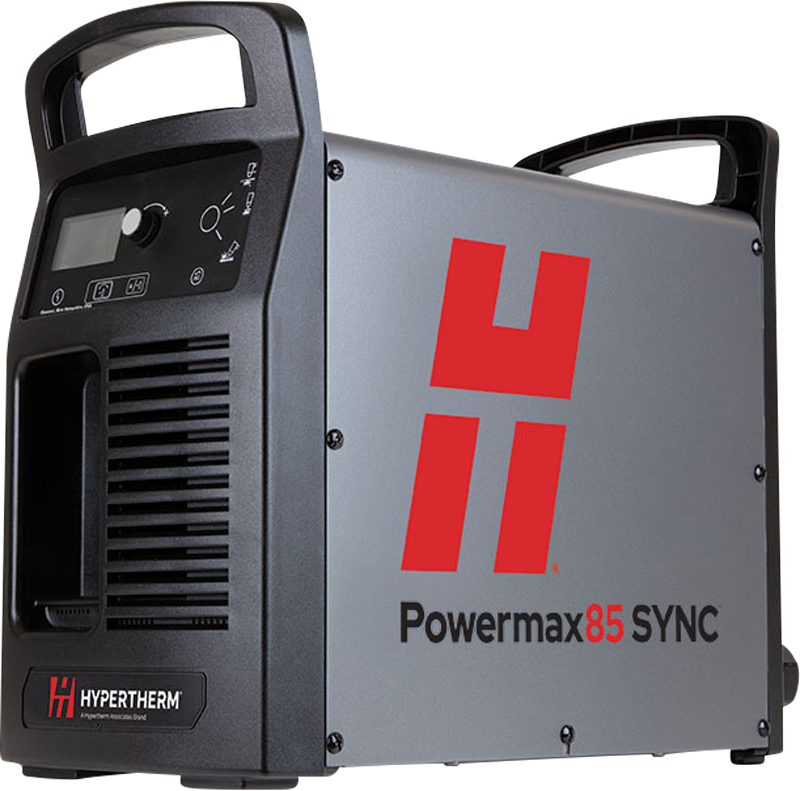
Four SYNC models run mechanised: the Powermax45 SYNC, Powermax65 SYNC, Powermax85 SYNC and Powermax105 SYNC. All four use the SYNC single-piece cartridge, which is the change that matters most day to day on a table. Above them sits the Powermax125, which is not a SYNC machine but is the usual answer when 105 amps is not enough and an industrial system is more than the job needs.

Pierce capacity is the number that decides whether the machine can start a cut inside the plate rather than running in from an edge. On a nest, edge starting costs you material and programming time, so pierce capacity is the practical limit on what the system will cut productively.
Every figure below is Hypertherm’s mechanised production pierce capacity with automatic torch height control fitted. Without automatic torch height control, pierce capacity drops by roughly one plate thickness step, which is the strongest argument there is for specifying torch height control on a Powermax table.
| System | Process amps | Production pierce | Severance | Cut speed at 12mm |
|---|---|---|---|---|
| Powermax45 SYNC | 10 - 45 A | 12 mm | 29 mm | 540 mm/min |
| Powermax65 SYNC | 20 - 65 A | 16 mm | 32 mm | 840 mm/min |
| Powermax85 SYNC | 25 - 85 A | 20 mm | 38 mm | 1,240 mm/min |
| Powermax105 SYNC | 30 - 105 A | 22 mm | 50 mm | 1,700 mm/min |
Severance capacity is the maximum thickness the system will part from an edge start. It is not a production figure - cut quality at severance thickness needs secondary work - but it tells you what the machine will get through in a pinch.
| System | Stainless production pierce | Aluminium production pierce |
|---|---|---|
| Powermax45 SYNC | 12 mm | 10 mm |
| Powermax65 SYNC | 12 mm | 12 mm |
| Powermax85 SYNC | 16 mm | 16 mm |
| Powermax105 SYNC | 20 mm | 20 mm |
Mild steel runs on air. Stainless can run on air, nitrogen or F5, and aluminium on air or nitrogen. Moving stainless or aluminium off air and onto nitrogen or F5 is the single cheapest cut quality improvement available on a Powermax, and it needs no hardware change beyond the gas supply.
Cut angle across the Powermax SYNC range sits in ISO 9013 range 5. For comparison, the MAXPRO200 sits in range 4 to 5 and the XPR range in 2 to 4, where a lower number is a squarer cut face.
That is the honest boundary. If cut face squareness is what drives your downstream welding cost, the MAXPRO200 or an XPR system is the right specification and no Powermax will get you there. If the work is thinner plate, lower duty, or a second table taking overflow, the Powermax range does it at a fraction of the capital cost.
If what you need is more thickness and more running time rather than a better cut face, there is a step between the two, and it is covered further down this page.
Older Powermax systems used a multi-piece consumable stack - electrode, swirl ring, nozzle, retaining cap and shield, each a separate part number, each able to be assembled wrong. The SYNC series replaces that entire stack with one cartridge.
The operator stocks and fits a single item. There is no stack to assemble, no wrong combination to build at 4pm on a Friday, and no part-number confusion between similar-looking nozzles.
When a cartridge is installed, the system reads it and sets gas pressure, amperage and cutting mode to match. On older systems that is three manual settings the operator has to get right, each one able to quietly cost cut quality if it is wrong.
On the 65, 85 and 105, the system tracks cartridge life and stops before a failed cartridge damages the torch or ruins the part in progress. On a mechanised table running unattended stretches, that is the difference between one scrapped part and a scrapped nest plus a torch.
The Powermax65, 85 and 105 SYNC expose consumable data through the serial interface, so the CNC can see cartridge state rather than relying on the operator to check.
Every mechanised Powermax includes a CPC machine interface port providing start, transfer and divided voltage signals. An RS-485 serial interface port is available for fuller control of the power source from the CNC, and it is the port that carries the cartridge data.
Arc voltage height control needs a divided voltage signal, which the CPC port provides, and an ohmic contact ring on the cartridge if ohmic initial height sensing is used. Height control is not an optional refinement on a Powermax table - it is what unlocks the pierce capacities in the tables above.
SmartSYNC machine torches come in full length and mini versions across lead lengths from 4.6 to 23 metres. Robotic torches are available in 45, 90 and 180 degree configurations for robotic cells and light industrial arms. Switching between a machine torch and a hand torch is a quick disconnect operation.
FineCut cartridges produce a narrower kerf with less dross and a smaller heat affected zone on thin plate. Hypertherm does not recommend FineCut for aluminium.
The Powermax45 SYNC will mark as well as cut, using the FineCut cartridge. Marking is not available on the 65, 85 and 105.
HyAccess cartridges give extra reach for cutting inside pipe and other confined geometry.
| System | Stainless production pierce | Aluminium production pierce |
|---|---|---|
| Powermax45 SYNC | 12 mm | 10 mm |
| Powermax65 SYNC | 12 mm | 12 mm |
| Powermax85 SYNC | 16 mm | 16 mm |
| Powermax105 SYNC | 20 mm | 20 mm |
Duty cycle is the share of any ten minute period the machine can hold an arc at full output. The practical read for a table: at 105 amps continuous the Powermax105 SYNC will cut for eight minutes in ten, and it will run all day at 94 amps. Single phase installations carry a lower duty cycle than three phase on the 65 and 85, which is worth checking against your shop supply before specifying.
The Powermax105 SYNC tops out at 105 amps and a 22 mm production pierce. The next step in most catalogues is an industrial system, but for some, that can be too large a jump in capital cost to justify. The Powermax125 sits in that gap, and it is the reason a lot of entry level CNC tables get specified the way they do.
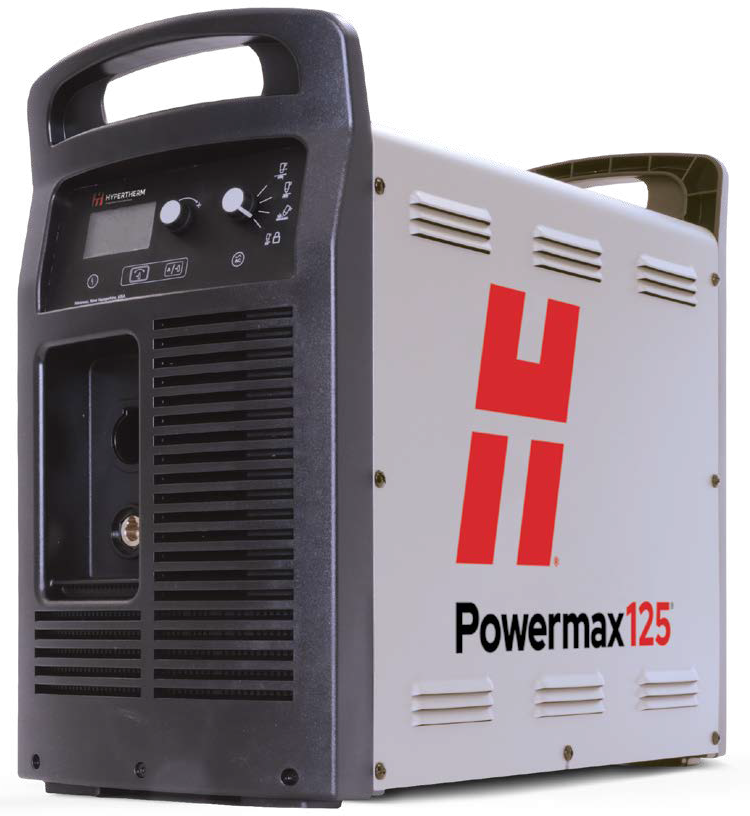
It is not a SYNC machine, and that is worth being clear about. The Powermax125 uses the older multi-piece Duramax Hyamp consumable stack rather than a single cartridge, so none of the cartridge simplicity described above applies to it. What it gives you instead is output and running time.
A 100% duty cycle at full output. This is the reason most Powermax125 tables get bought. The Powermax105 SYNC manages 80% at best and less on some supplies, so at full output it cuts for eight minutes in ten. The Powermax125 holds 125 amps continuously. On a table running back to back nests, that is production capacity rather than a specification detail.
| Powermax105 SYNC | Powermax125 | |
|---|---|---|
| Process amps | 30 - 105 A | 30 - 125 A |
| Mild steel production pierce | 22 mm | 25 mm |
| Mild steel severance | 50 mm | 57 mm |
| Cut speed at 12mm | 1,700 mm/min | 2,050 mm/min |
| Duty cycle at full output | 80% at 480 - 600 V 3-PH | 100% |
| Consumables | Single-piece SYNC cartridge | Multi-piece Duramax Hyamp stack |
Hypertherm’s recommended cut capacity for the Powermax125 is 38 mm at 457 mm/min, with severance to 57 mm. On a mechanised table with automatic torch height control, production pierce is 25 mm.
It carries its own versions of the features that matter on a table. Smart Sense sets gas pressure automatically, so that is one less thing to get wrong. Electrode end of life detection stops the arc before a worn electrode damages the torch or the workpiece. There are eleven Duramax Hyamp torch styles covering full length, mini and robotic mounting, and six consumable types covering drag cutting, fine feature, flush, mechanised and two gouging profiles. The power supply carries a six year warranty.
For New Zealand the relevant specification is the CE model: 400 V three phase, 36 A input at 400 V, 305 VDC open circuit, 21.9 kW at the torch and 49 kg with a 7.6 metre torch. It runs on clean, dry, oil-free air or nitrogen at 550 scfh and 85 psi for cutting.
One thing the Powermax125 does not buy you is a squarer cut. Cut angle sits in ISO 9013 range 5, the same as the SYNC range. It buys thickness, speed and duty cycle. If cut quality is what you are chasing, the step is to the MAXPRO200 or an XPR system, not to the 125.
Every Powermax SYNC model is available as a power source option on the Plazmax CutAce, as is the Powermax125. Every machine ships with full installation, operator training and NZ-based technical support. We build the table, we integrate the power source, and you have one number to call for both.
For heavier duty work, the CutPro pairs with higher output power sources.
As an Authorised Hypertherm OEM Channel Partner, Plazmax supplies genuine Powermax SYNC cartridges, SmartSYNC torches, leads and ohmic sensing rings throughout New Zealand, for Plazmax tables and for any other brand of table running a Powermax power source.
Full fitment detail by amperage, process and material is on our Powermax consumables page, and everything is orderable with NZ pricing and stock in our online shop.
Plazmax has a technical team on the ground in New Zealand that services any Hypertherm-powered plasma cutting system, regardless of machine brand. That covers scheduled servicing, breakdown support and remote diagnostics on Powermax systems fitted to tables we did not build. Details are on our service and support page.
Shops cutting predominantly thinner plate on a CNC table, running a pipe or track cutter, or fitting a compact power source to a robotic cell. It is Hypertherm’s light to medium duty mechanised range. Mild steel production pierce runs from 12 mm on the Powermax45 SYNC to 22 mm on the Powermax105 SYNC.
Choose Powermax when the plate is thinner and capital cost matters more than cut face squareness. Step up when you are cutting heavy structural plate, or when cut angle drives downstream welding cost. Powermax sits in ISO 9013 range 5, the MAXPRO200 in 4 to 5 and the XPR range in 2 to 4.
SYNC replaces the multi-piece consumable stack with a single cartridge, and the power supply reads the cartridge and sets gas pressure, amperage and cutting mode automatically. The 65, 85 and 105 also detect cartridge end of life before it damages the torch.
For anything beyond the thinnest plate, yes. Every pierce capacity Hypertherm publishes for these systems assumes automatic torch height control. Without it, pierce capacity drops by roughly one thickness step and cut angle suffers as the cartridge wears.
In New Zealand, yes. Our technical team services any Hypertherm-powered system regardless of who built the table, and we supply the consumables and parts for it.
Yes. Mild steel runs on air. Stainless runs on air, nitrogen or F5, and aluminium on air or nitrogen. Nitrogen or F5 gives noticeably better cut quality on both than air does.
"*" indicates required fields